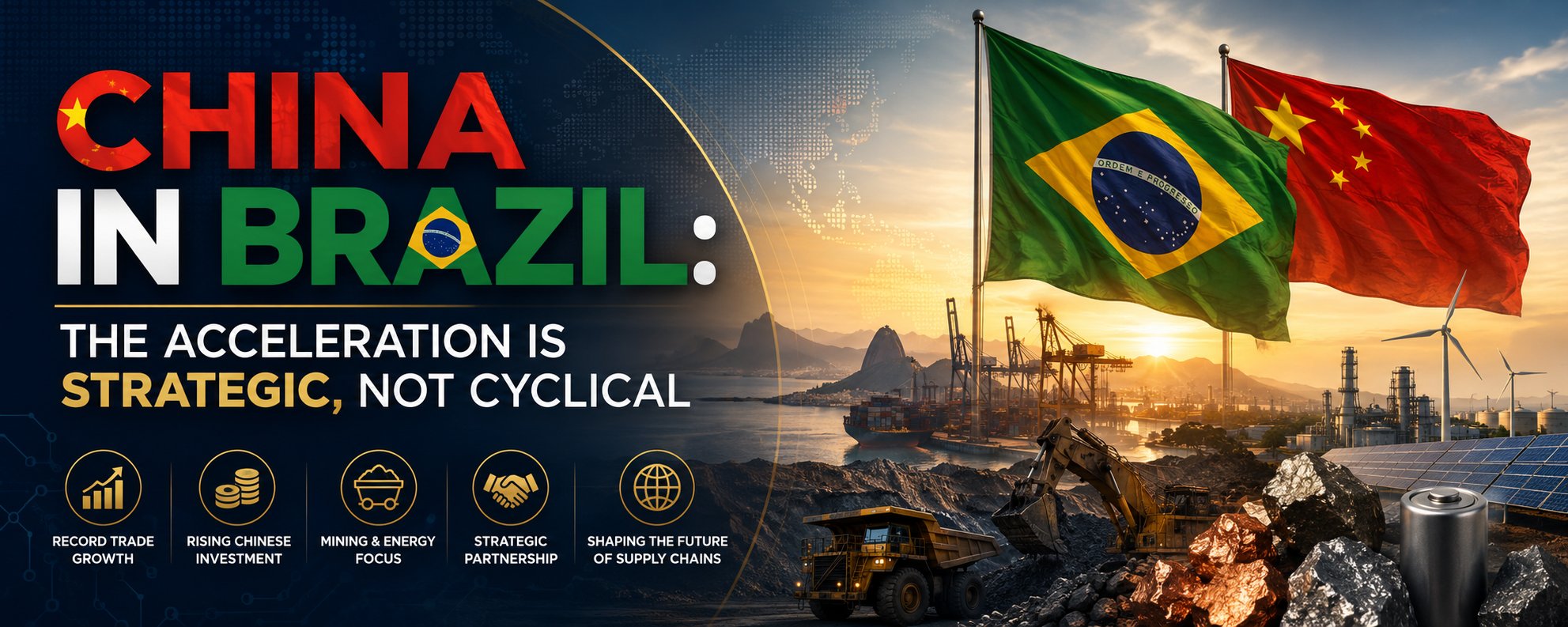
China in Brazil: The Acceleration Is Strategic, Not Cyclical
Chinese capital is no longer confined to commodity trade. It now spans equity stakes, project finance, infrastructure control and technology partnerships — and the institutional architecture is deepening.
In Q1 2026, the Brazil–China relationship entered a new phase. The volume is record-breaking. The composition is shifting. And the strategic implications for energy, mining and critical minerals are more consequential than most market coverage acknowledges.
US$171B
Bilateral trade Full-year 2025 record
Brazil exports > US$100B
US$23.9B
Brazilian exports to China Q1 2026
+21.7% year-on-year
US$6.1B
Chinese FDI in Brazil 2025
+45% vs 2024
Brazilian exports to China — US$ billions · 2021–Q1 2026
Sources: MDIC · CEBC (China-Brazil Business Council) · Stratis Intelligence estimates for 2021–2024
The shift in character
From Opportunistic to Institutional
China's strategic interest in Brazil is not new. What has changed is the architecture of that interest. In 2025, bilateral trade hit a record US$171 billion, with Brazilian exports to China surpassing US$100 billion for the first time — driven by iron ore, soybeans, oil, and a rapidly expanding critical minerals component. In Q1 2026 alone, Brazilian exports reached US$23.9 billion, up 21.7% year-on-year, according to the Brazilian Ministry of Development, Industry and Foreign Trade (MDIC).
Chinese foreign direct investment in Brazil rose 45% in 2025 to US$6.1 billion, with energy and mining projects leading the surge. More significant than the volume is the composition: capital is no longer flowing primarily into commodity trade and regulated infrastructure. It is moving into nickel, copper, lithium processing and other critical minerals tied to batteries, electrification and industrial decarbonisation.
The signal that most clearly marks the shift in character is the new BNDES–CEXIM co-investment framework, targeting up to US$1 billion in structured projects. This is not deal-by-deal capital allocation — it is institutionalised deployment. China is building a channel, not closing a trade.
Key insight
"China is not simply buying Brazilian assets. It is helping finance Brazil's energy and mineral system while also increasing its own strategic footprint."
The distinction matters for investors, policymakers and companies with Brazilian exposure. A transactional relationship can be unwound. An institutional one cannot.
Global context
Why Brazil, Why Now
Two global forces are making Brazil a more strategic destination for Chinese capital than at any previous point in the bilateral relationship.
The first is energy security. The ongoing Middle East conflict has elevated concerns about supply chain reliability for crude oil, LNG and industrial inputs. Brazil's pre-salt reserves — producing over 2.7 million barrels per day, conflict-free, from the Atlantic Basin — represent a geographically diversified supply source that no other major producer currently replicates.
The second is artificial intelligence. The explosive growth of AI infrastructure is driving unprecedented demand for reliable power and critical minerals — particularly nickel, copper and lithium, of which Brazil holds substantial reserves. For China, which is simultaneously the world's largest consumer of critical minerals and the country most exposed to Western supply chain restrictions, Brazil's mineral endowment is not an investment opportunity. It is a supply security imperative.
Chinese FDI in Brazil by sector — 2025 composition (illustrative)
Stratis Intelligence sectoral composition estimate based on CEBC and public deal data · 2025
The structural trade-off
Asymmetry and the Value Capture Question
The bilateral relationship is economically beneficial for Brazil. It is also structurally asymmetric in ways that have not improved meaningfully over the past decade. Brazil exports raw or semi-processed materials — iron ore, soybeans, oil, and increasingly unprocessed critical minerals. China supplies machinery, grid hardware, batteries, panels and engineering services. The trade pattern is efficient for both parties in the short term. It is strategically limiting for Brazil in the long term.
Technology transfer is present but uneven. The Windey Energy Technology Group–SENAI CIMATEC collaboration in clean energy R&D represents a more deliberate effort to build local capability. But one partnership does not change a structural pattern. Without content requirements, IP safeguards and local capability-building targets embedded in project agreements, technology transfer remains shallow even when investment headlines look large.
The BNDES–CEXIM co-investment framework is an opportunity to change this dynamic — if Brazil uses the negotiating leverage of a record-breaking bilateral relationship to insist on processing, localisation and genuine technology diffusion as conditions of structured capital deployment.
Structural risk
Without explicit industrial policy requirements attached to Chinese capital inflows, Brazil risks deepening its role as a raw material supplier rather than advancing up the value chain. The window to negotiate better terms is now — while Brazilian assets are in high demand. It narrows as dependence deepens.
Outlook
Three Scenarios for 2026–2028
Base case
Chinese investment in Brazil's energy and mining sectors continues to expand through 2026–2027, supported by the BNDES–CEXIM channel. Trade volumes remain at record levels. The structural asymmetry persists but does not worsen materially.
Upside case
Brazil uses record bilateral volumes to negotiate content requirements and IP protections in structured deals. Chinese capital accelerates grid build-out and mineral processing. Brazil advances meaningfully up the value chain in critical minerals.
Downside case
Brazil becomes strategically dependent on Chinese-controlled platforms in critical infrastructure and mineral supply chains. Technology diffusion remains shallow. Export concentration in raw materials deepens, limiting industrial upgrading options.
Stratis view
China's engagement in Brazil is accelerating at a moment when global supply chain security has never been more important. For international investors and companies with Brazilian exposure, this is no longer a peripheral story — it is a central variable shaping long-term risk and opportunity in energy and mining.
The capital is flowing faster than ever. The real question is whether Brazil can convert this momentum into genuine industrial upgrading — or whether the relationship will remain structurally tilted toward China's long-term supply security objectives.
Access the full report
Download the complete analysis
Free access. Enter your details below and receive the full PDF report immediately.